Commercial Gutters in Chicago, IL

Commercial gutters Chicago IL: larger systems for large roofs

Commercial gutters for Chicago buildings: larger troughs, scuppers, box gutters, and internal leaders, sized for the roof areas and water volumes homes never see.

Commercial Gutters in Chicago, IL
About this service

Bigger roofs, bigger water, different systems

Commercial gutter work starts from a different scale. Larger roof areas collect more water, longer runs carry it further, and flat roofs drain through parapets, scuppers, and internal leaders rather than eave troughs. The components grow with the job: 7-inch and 8-inch troughs, 4 by 5 inch downspouts, galvanized steel, and box gutters built into the roof edge. A system sized for a bungalow, fitted to a building with ten times the roof area, will overflow at the first heavy rain, and the failure will show on the walls below.

The buyer is different too. Building owners and property managers weigh a gutter system against the whole building: the tenants below, the storefronts at street level, the parapet and facade above, and the maintenance rhythm across many units. Flat-roofed stock dominates much of this work, from greystone rows to courtyard apartment buildings, and the drainage system is part of the roof, not an accessory to it. In Avondale and North Lawndale, flat-roof drainage through parapets and rear leaders is the everyday system, and larger buildings extend the same logic to a bigger scale.

Responsibility varies by building. In multi-unit and association-managed buildings, who owns the gutters, the association, the owner, or the unit holder, depends on the building's own documents, and no general rule is stated here. That question is settled per building before scope is agreed, and it is asked early, not discovered mid-job. Where the building is a larger version of a familiar house, a big two-flat or a small apartment building, gutter repair thinking still applies, scaled up. Where it is a different system entirely, this page is the right starting point.

  • ✓ Larger troughs and downspouts
  • ✓ Flat-roof parapet and scupper drainage
  • ✓ Box gutters on larger buildings
What's included

What commercial gutter work covers

Covered below: Larger troughs and downspouts; Flat-roof parapet and scupper drainage; Box gutters on larger buildings — and the rest of the checklist.

01
✓

Larger troughs and downspouts

Commercial systems use larger components because roof areas demand them: 7-inch and 8-inch troughs where residential work uses 5- and 6-inch, and 4 by 5 inch downspouts to carry the flow those troughs collect. Sizing follows the roof area feeding each run and the points where valleys and parapets concentrate flow. Undersized components on a large roof are the most common commercial failure, showing as overflow at the lowest point.

02
✓

Flat-roof parapet and scupper drainage

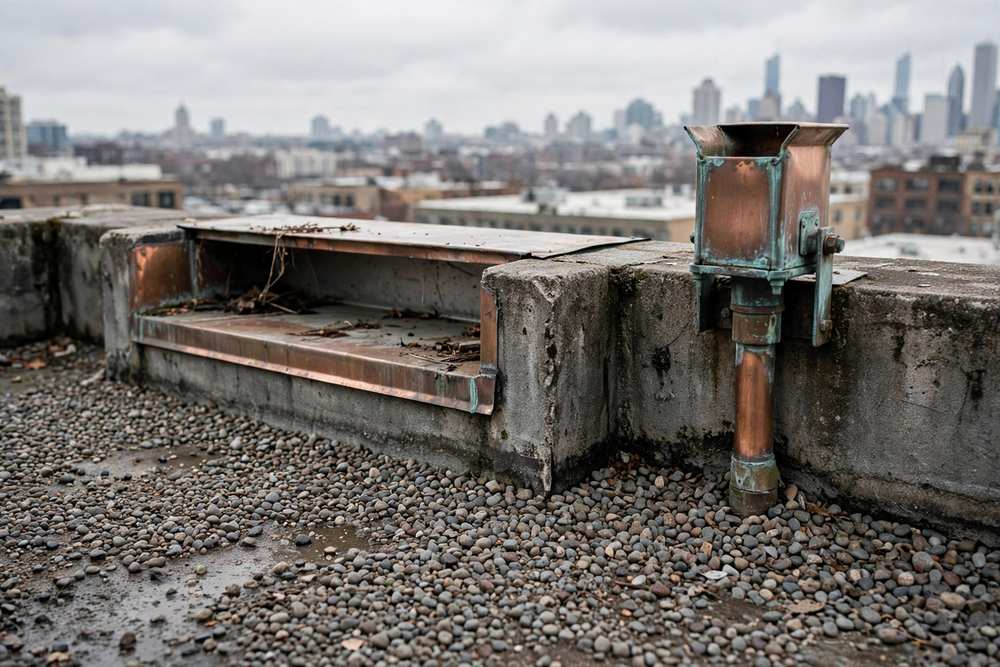
Flat roofs drain through the parapet: scuppers, openings in the parapet wall, pass water to leaders outside, and internal leaders carry it down through the building. Scupper repair and leader work are core commercial scope, since a blocked scupper ponds water on the roof and a failed leader leaks inside the wall. Greystone stock in West Garfield Park, where scope is flat-roof-only, shows the system at residential scale.

03
✓

Box gutters on larger buildings

Box gutters, troughs built into the roof edge behind a cornice or parapet, appear on larger, older buildings where the gutter is part of the architecture. They fail as a system: lining, outlet, and surrounding woodwork read together, since a worn lining and a choked outlet produce the same stain. Box-gutter work on a larger building is planned with the facade in mind, because trough and cornice are one line.

04
✓

Galvanized steel systems

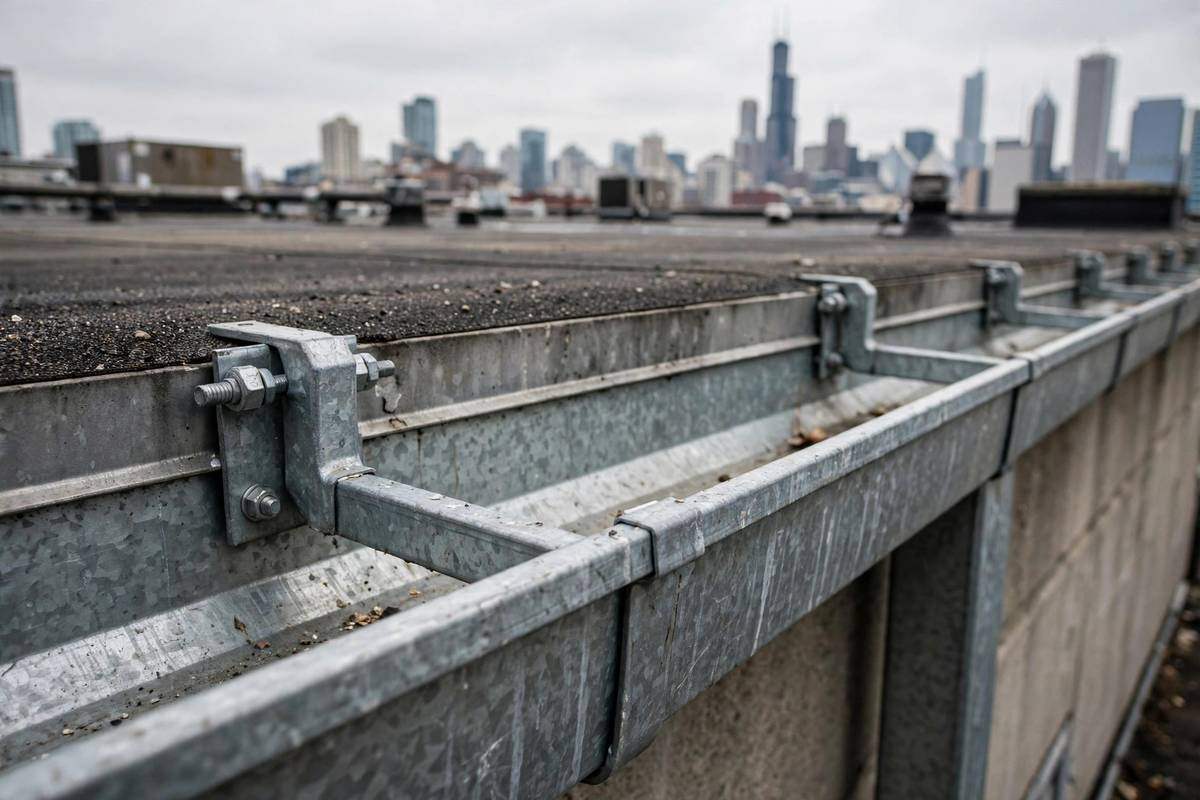
Galvanized steel is the material most associated with larger and commercial systems: strong, rigid, and suited to long runs and wide troughs. Steel lives on this page, not as a separate service, because its use follows the building rather than the material alone. Where steel meets other metals at junctions, compatibility is planned, not improvised, and the system is read as a set of metals from trough to discharge.

05
✓

Maintenance rhythm for larger roofs

Larger roofs collect more debris across more area, and their drainage has more points of failure: more scuppers, more leaders, more joints, more corners. A maintenance rhythm clearing and checking the whole system seasonally catches blocked scuppers and choked leaders before they pond water on the roof. Mixed-use blocks in Near West Side, where townhomes sit beside larger buildings, show the range one maintenance round can cover.

How it works

How commercial gutter work runs

The job starts with a call to (872) 867-8606 during business hours: Mon–Sat 6:00 AM–5:00 PM, Sun 6:00 AM–1:00 PM. The call covers the building type, the roof form, and who holds responsibility for the drainage system.

The visit walks the building: roof edges, parapets, scuppers, leaders, and the elevations below. The system is read as a whole, since a failure at one scupper can pond water far from where it shows.

Scope, sizing, and responsibility are discussed together, including who owns each part of the system in a multi-unit building. Timing and access are discussed up front, since larger buildings have more people affected by the work.

Troughs, scuppers, leaders, and box sections are repaired or fitted as the scope requires, with downspout repair and fascia repair thinking applied where leaders and eave boards are part of the failure.

Water is run through the system to confirm every scupper, leader, and trough carries its share and discharges where planned. A large system is checked as a system, not fitting by fitting.

Commercial Gutters process in Chicago
STEP 01Call during business hours

The job starts with a call to (872) 867-8606 during business hours: Mon–Sat 6:00 AM–5:00 PM, Sun 6:00 AM–1:00 PM. The call covers the building type, the roof form, and who holds responsibility for the drainage system.

Tools & methods

Materials and equipment in commercial work

01
✓

Large-profile troughs

Troughs in 7-inch and 8-inch profiles carry the water volumes larger roofs produce, formed and fitted to the runs they serve. Profile choice follows the roof area and the architecture, with box sections where the trough is built into the roof edge.

02
✓

Scupper parts and flashing

Scupper boxes, throats, and flashing form the openings through which flat roofs drain, and their fit to the parapet decides whether water passes through or finds the wall. Scupper work is flashing work as much as gutter work, and the joint is read accordingly.

03
✓

Internal leader parts

Internal leaders carry water down through the building, and their joints, brackets, and outlets are read from roof to discharge. A failed internal leader leaks inside the wall, so the reading covers the full length, not just the visible ends.

04
✓

Galvanized steel stock

Galvanized steel stock feeds the forming of larger troughs, box sections, and leaders, with joints sealed and fitted to the runs they serve. Steel's rigidity suits long commercial runs, and its weight is planned into hanger and bracket spacing.

05
✓

Sealants for large joints

Sealants close the joints where large sections meet, where scuppers pass through parapets, and where leaders turn. Large joints move with temperature, and the seal has to move with them rather than crack across the joint.

06
✓

Access equipment for taller buildings

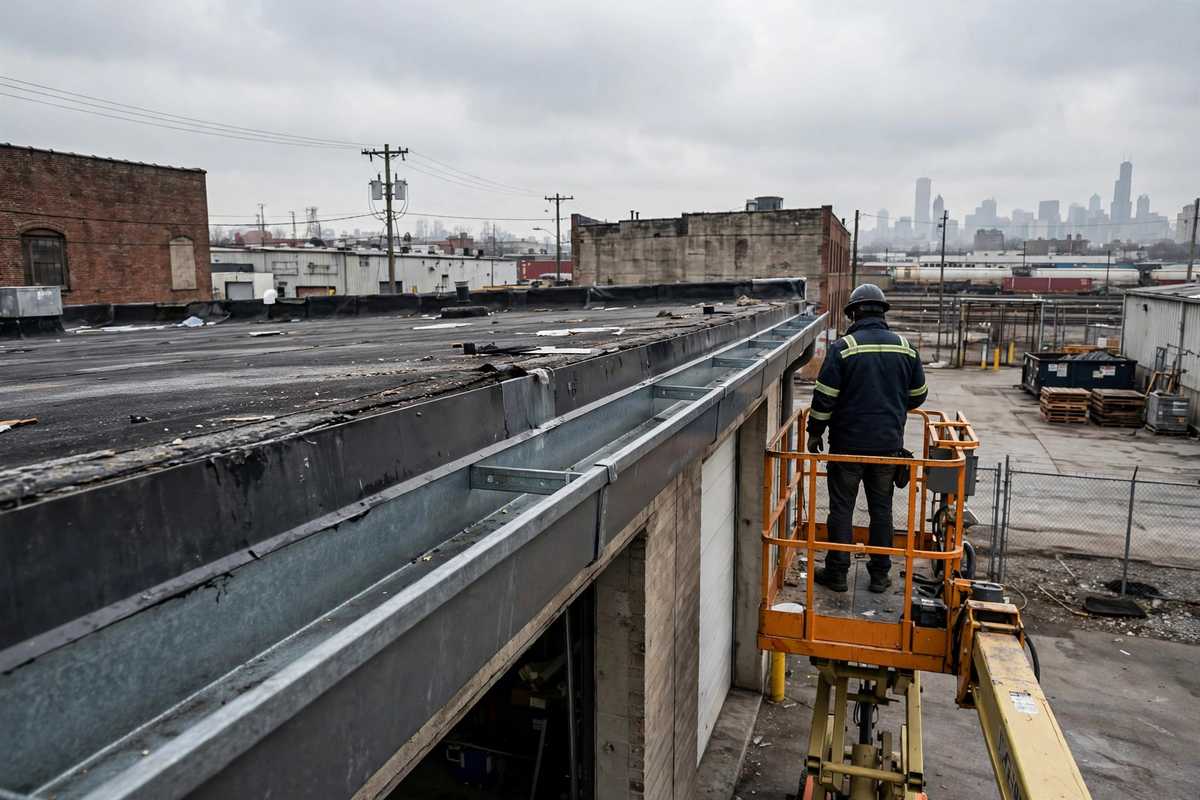
Access equipment is chosen for the height and shape of the building, from low parapets to taller elevations. Gutter installation methods scale up with the building, and the setup is planned per elevation rather than assumed.

Typical cases

Typical commercial situations

Scupper opening in a parapet wall above a flat roof
Gutter Repair

A typical flat-roof apartment building with scupper trouble

A typical flat-roofed apartment building where water ponds near one parapet after rain: a scupper is blocked, and the leader below it runs slowly. The approach clears and repairs the scupper, checks the leader for the full length, and tests the roof drainage as a system.

The tenants below never see the roof, so the seasonal check is what stands between a blocked scupper and a ceiling stain three floors down.

Call (872) 867-8606 →
Rear leaders draining a parapet above a mixed-use building
Gutter Repair

A typical mixed-use building with parapet drainage

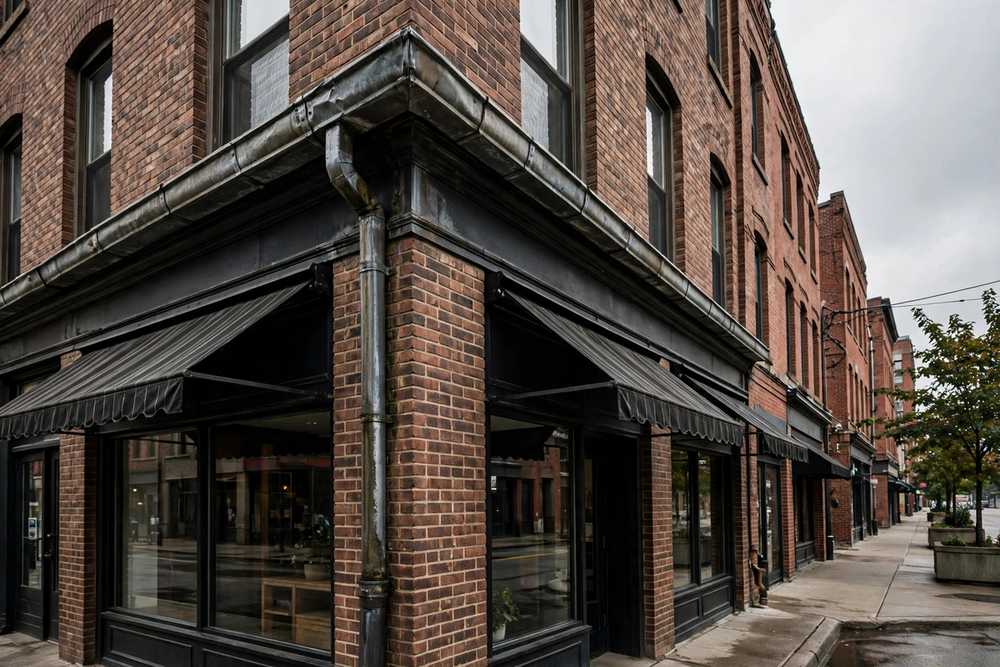
A typical mixed-use building with flats over a storefront: the parapet drains through scuppers to leaders on the rear elevation, and a failed leader stains the wall above the shop. The approach repairs the leader, checks the scuppers feeding it, and reads the storefront parapet as part of the same system.

The work is planned around the building's use, with access and timing discussed up front. Access is arranged with the building's occupants in mind, and the leaders are tested under water before the visit ends.

Call (872) 867-8606 →
Long gutter runs on a large pitched roof with valley outlets
Gutter Repair

A typical larger pitched roof needing oversized parts

A typical larger pitched roof, long runs feeding few outlets, where the troughs overflow at the valley bottoms during heavy rain: the components are residential-sized on a commercial-scale roof. The approach steps up trough and leader sizes, adds an outlet where a valley concentrates flow, and checks discharge at the ground. Courtyard and greystone streets in Hyde Park show larger buildings beside two-flats, where the same rain falls on very different roof areas.

Call (872) 867-8606 →
Problems we solve

Problems commercial gutter work solves

These are the commercial gutters problems Chicago homeowners call about most, and how each one is approached.

Ask a pro →
01

Undersized components on big roofs

Residential-sized troughs and leaders on a large roof overflow at the first heavy rain, and the overflow runs down walls and over entrances. Sizing components to the roof area, and adding outlets where flow concentrates, addresses the cause. The overflowing gutters explanation covers the same logic at house scale.

↗
02

Blocked scuppers ponding water

A blocked scupper leaves water standing on a flat roof, loading the structure and finding every weak joint in the roof surface. Clearing and checking scuppers on a seasonal rhythm is the simplest protection a flat roof has, and it is the first item on any commercial maintenance round.

↗
03

Internal leader leaks inside walls

A failed internal leader leaks where nobody can see it, inside the wall, and the first sign is often staining far from the failure. Reading leaders for their full length, and testing them under water, catches the failure before the stain spreads. Early attention keeps a hidden leak from becoming wall damage.

↗
04

Deferred maintenance across many units

In larger buildings, drainage trouble is nobody's daily job, so small failures accumulate across many scuppers and leaders until a storm finds them all at once. A seasonal rhythm with a named scope turns deferred maintenance into planned maintenance. Boulevard-scale buildings in Logan Square show the stakes where large footprints meet tall eaves.

↗
Proof you can check

Facts you can check before you call

  • 5.0-star Google rating · 17 Google reviews
  • Business address · 2332 N Laramie Ave, Chicago, IL 60639
  • Business hours · Mon–Sat 6:00 AM–5:00 PM, Sun 6:00 AM–1:00 PM
  • Phone · (872) 867-8606
  • Service area · Chicago, IL
Neighbors recommend us

What Chicago homeowners say

★★★★★
“Luis promptly came out for both fascia and window molding repair. Great work at a fair price. I'd definitely use him again.”
SS

Stan SheftGoogle review · 2 years ago

★★★★★
“The team came out in less than 24 hours to give a quote and started the job the same day. Very professional and did a clean job! We will be using them again! Highly recommend for guttter cleaning!”
DD

Dave DavisGoogle review · 2 years ago

Good questions

Commercial Gutters questions Chicago homeowners ask

(872) 867-8606 →

Commercial work commonly uses 7-inch and 8-inch troughs with 4 by 5 inch downspouts, against 5- and 6-inch residential sizes, with box gutters and scuppers where the roof form calls for them. Sizing follows the roof area feeding each run. Call (872) 867-8606 during business hours to discuss a particular building.

It depends on the building's own documents: the association, the owner, or the unit holder may hold responsibility for different parts of the system, and no general rule is stated here. The question is settled per building before scope is agreed. Call (872) 867-8606 during business hours to talk through a particular building.

Flat roofs drain differently: through parapet scuppers and internal leaders rather than eave troughs, with eave gutters mainly on porches, dormers, and pitched additions. The drainage system is part of the roof, and it is read as a system, from scupper to discharge. The replacement signs apply to the trough sections of mixed buildings.

A seasonal rhythm, fall and spring, matches the residential advice and matters more at commercial scale, since larger roofs have more scuppers, leaders, and joints to fail. The repair-or-replacement comparison frames the judgment between repairing a failing section and replacing a failing system.

It depends on the building's size, roof form, component sizes, and whether the work is repair, partial replacement, or a full system. For a quote on a specific building, call (872) 867-8606 during business hours: Mon–Sat 6:00 AM–5:00 PM, Sun 6:00 AM–1:00 PM. The office is at 2332 N Laramie Ave, Chicago, IL 60639.

Ready when you are

Get commercial gutters help in Chicago

Call (872) 867-8606 during business hours — Mon–Sat 6:00 AM–5:00 PM, Sun 6:00 AM–1:00 PM — and tell us what is happening with your gutters.

Call (872) 867-8606 →
Get in touch by phone

Talk to a Chicago gutter crew

Call (872) 867-8606 during business hours. Tell us what is happening with your gutters and we will talk through the next step on the phone.

Call during business hours(872) 867-8606
Office address2332 N Laramie Ave, Chicago, IL 60639
Office hoursMon–Sat 6:00 AM–5:00 PM, Sun 6:00 AM–1:00 PM
↗
Questions?Call now