Seamless Gutter Installation in Chicago, IL

Gutter installation Chicago IL: seamless systems for Chicago rooflines

Seamless gutter installation for Chicago homes, from bungalow eaves to two-flat rooflines, with the size, profile, and material matched to the house it serves.

Seamless Gutter Installation in Chicago, IL
About this service

Gutter installation shaped by Chicago housing

Chicago is a city of older homes. The median year built for Chicago housing units is 1953, according to American Community Survey 2020-2024 five-year figures, and the Bungalow Belt holds roughly 80,000 brick bungalows built from about 1910 to 1940. Two- and three-flats make up about a quarter of the housing stock. That mix means no single gutter layout fits every house: pitched eaves call for one approach, and flat roofs with parapets call for another. Blocks of near-identical bungalows fill Portage Park, while the blocks around the business address in Belmont Cragin mix bungalows, Cape Cods, and two-flats.

Seamless gutters are formed in long, continuous runs, with joints mainly at corners and end caps, while sectional gutters join shorter lengths along every run. Fewer joints means fewer places for a seam to open over time. The comparison matters most on long, straight bungalow eaves, where a single run can cover the whole side of a house, and on rooflines broken by valleys and dormers, where every joint is a decision. The seamless versus sectional comparison sets out the trade-offs in plain terms, and gutter repair covers the point where an aging system stops being worth patching.

Gutter Lake City - Gutters Installation & Repair is based at 2332 N Laramie Ave, Chicago, IL 60639, and works in Chicago. A new installation starts with the roofline as it stands: the pitch, the length of each run, the valleys and dormers, and the condition of the boards the gutters will hang from. Size, profile, and material follow from that reading, not from a single standard package, because a low-pitched bungalow eave and a tall two-flat rear elevation ask for different answers.

  • ✓ Seamless runs for pitched eaves
  • ✓ Full replacement of an aging system
  • ✓ 6-inch and oversized capacity
What's included

What gutter installation covers

Covered below: Seamless runs for pitched eaves; Full replacement of an aging system; 6-inch and oversized capacity — and the rest of the checklist.

01
✓

Seamless runs for pitched eaves

Most Chicago bungalows and cottages carry water on pitched eaves, and K-style aluminum is the profile homes of this era typically wear. A seamless run follows the eave in one length, without a joint every few feet. Dormers, porch roofs, and rear additions each add short runs, and detached garages backing to alleys often need one of their own. Boulevard blocks such as Logan Square make that reading matter more.

02
✓

Full replacement of an aging system

Replacement folds old and new systems into a single job. Old gutters and downspouts are removed, fascia boards are checked while exposed, and new runs are fitted to the eaves as they stand. Where boards are soft or damaged, fascia repair comes first, because new gutters hung on failing boards will not stay true. Replacement fits when leaks, sagging, and loose hangers keep returning across the whole system.

03
✓

6-inch and oversized capacity

Standard residential gutters are commonly 5 inches wide, and 6-inch gutters add capacity for roofs shedding much water at once: steep pitches, long runs, and large roof areas feeding a single eave. Oversized downspouts, often 3 by 4 inches, pair with the wider trough so capacity is not choked at the outlet. Wide-lot homes in Forest Glen, with ranch and split-level runs, are where the wider size earns its place.

04
✓

Materials compared: aluminum, vinyl, and sectional

Aluminum dominates Chicago residential work for a plain reason: it is light, it forms well, and it does not rust. Vinyl is the material to weigh carefully, because vinyl can turn brittle in freezing weather, and Chicago winters spend long stretches near and below freezing. Sectional gutters trade easier handling against a joint at every connection. Homes where a different metal fits the architecture can look at copper gutters instead.

05
✓

Fitting the system to the roofline

Valleys concentrate water where two roof planes meet, dormers add short runs and inside corners, and porch roofs add a lower eave line. Each changes where water arrives and how fast, so outlets and downspouts are placed around them, not spaced by habit. Garages, additions, and coach-house roofs get the same reading. Guards, where wanted, are chosen then, since gutter guards fit differently by profile and tree cover.

How it works

How an installation job runs

Every job starts with a phone call to (872) 867-8606 during business hours: Mon–Sat 6:00 AM–5:00 PM, Sun 6:00 AM–1:00 PM. The call covers what is happening with the current gutters, the type of home, and a visit to look at the roofline.

The visit reads the house as it stands: eave lengths, pitch, valleys, dormers, porch roofs, and the condition of the fascia boards. Flat-roofed sections, parapets, and rear elevations are noted separately, since they drain differently from pitched eaves.

Size, profile, and material are discussed against what the roofline showed: 5-inch or 6-inch troughs, K-style or another profile, aluminum or another material, and where each downspout will discharge. Questions are answered before any work is agreed.

Old gutters come off where the job is a replacement, and new runs are formed, fitted, hung, and joined to downspouts. Hangers are set into solid boards, outlets are placed where the roofline sends water, and the work area is left tidy.

Before the job is finished, water is run through the system to confirm it travels along each run, drops through each downspout, and discharges where planned. Anything that ponds, drips at a joint, or misses its outlet is put right while the visit is still underway.

Seamless Gutter Installation process in Chicago
STEP 01Call during business hours

Every job starts with a phone call to (872) 867-8606 during business hours: Mon–Sat 6:00 AM–5:00 PM, Sun 6:00 AM–1:00 PM. The call covers what is happening with the current gutters, the type of home, and a visit to look at the roofline.

Tools & methods

Materials and equipment in an installation

01
✓

On-site forming equipment

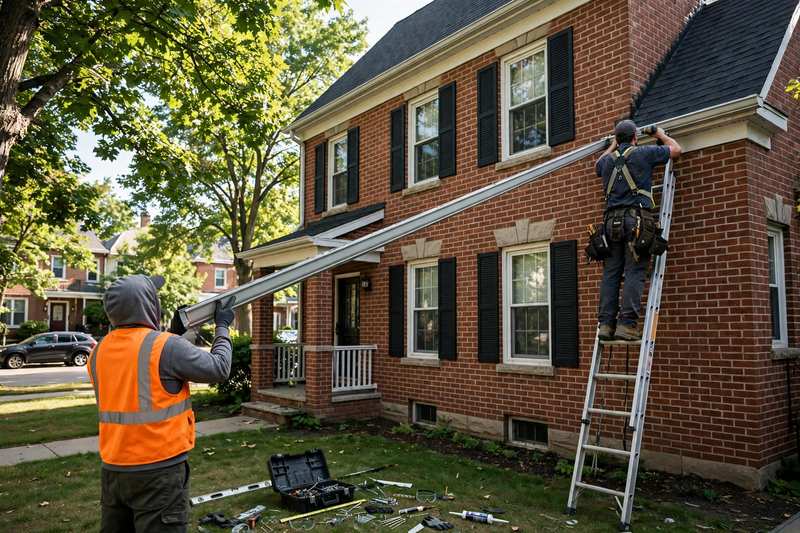
Seamless runs are shaped on site from coil stock, so each length matches the eave it will serve without a factory joint in the middle. Forming on site also means corners and end caps are fitted to the house rather than the house adapting to stock lengths.

02
✓

Aluminum coil and profiles

Aluminum coil feeds the forming equipment, and the profile, most often K-style on Chicago homes of this era, gives the trough its shape and stiffness. Profile choice follows the roofline and the look of the house, not a single default.

03
✓

Hangers and fasteners

Hangers carry the weight of the trough, the water in it, and the snow and ice that gather in winter. They are fixed into solid fascia boards at spacings suited to the run, and loose or failing hangers are a common reason older runs pull away.

04
✓

Sealant, corners, and end caps

Joints at corners and end caps are the places a seamless system still has seams, so they are sealed and fitted with care. A failed corner seal is one of the most common sources of a drip that looks like a gutter problem and behaves like a joint problem.

05
✓

Downspout parts and outlets

Outlets, elbows, and downspout lengths carry water from the trough to the ground, and their size has to match the trough above them. Where the fascia behind an outlet is damaged, fascia repair is part of the conversation before new parts are hung.

06
✓

Ladders and safe access

Ladders and access equipment are chosen for the height and shape of each elevation, from single-story bungalow eaves to taller two-flat rear walls. Stable, level footing matters on every visit, and overhead lines, trees, and soft ground are checked before work starts.

Typical cases

Typical installation situations

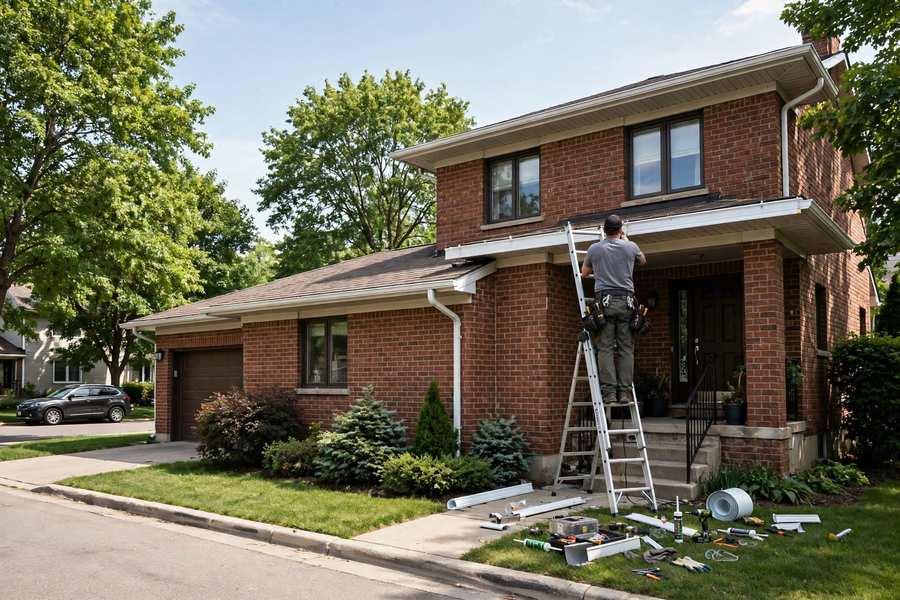
Brick bungalow with a new seamless gutter along the front eave
Seamless Gutter Installation

A typical bungalow replacement

A typical 1920s brick bungalow with its original sectional gutters: joints weeping at several points, one run sagging toward the middle, and paint peeling where overflow has run down the brick. The approach is a full replacement in seamless aluminum, sized to the eave lengths and the dormer valleys, with outlets placed where the roof sends water and downspouts discharging away from the foundation. Blocks of homes like this fill Chatham, where bungalow after bungalow shares the same low-pitched, overhanging-eave roofline.

Call (872) 867-8606 →
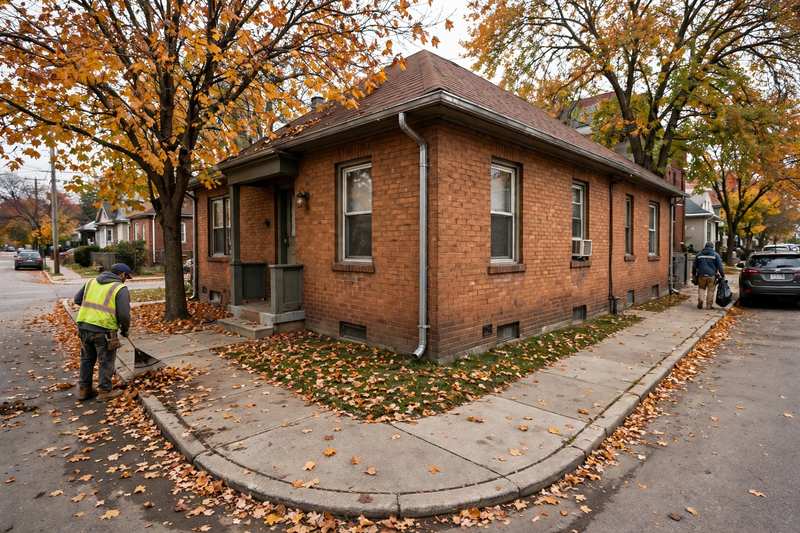
Brick two-flat showing a flat roof edge beside a pitched rear addition
Seamless Gutter Installation

A typical two-flat with two drainage systems

A typical brick two-flat with a flat main roof and a pitched rear addition: the flat section drains through a parapet and rear leaders, while the addition and porch roofs carry conventional eave gutters. The approach reads each system on its own terms, replacing the eave runs and checking that the rear leaders still carry water clear of the building, rather than forcing one gutter layout across both roof forms.

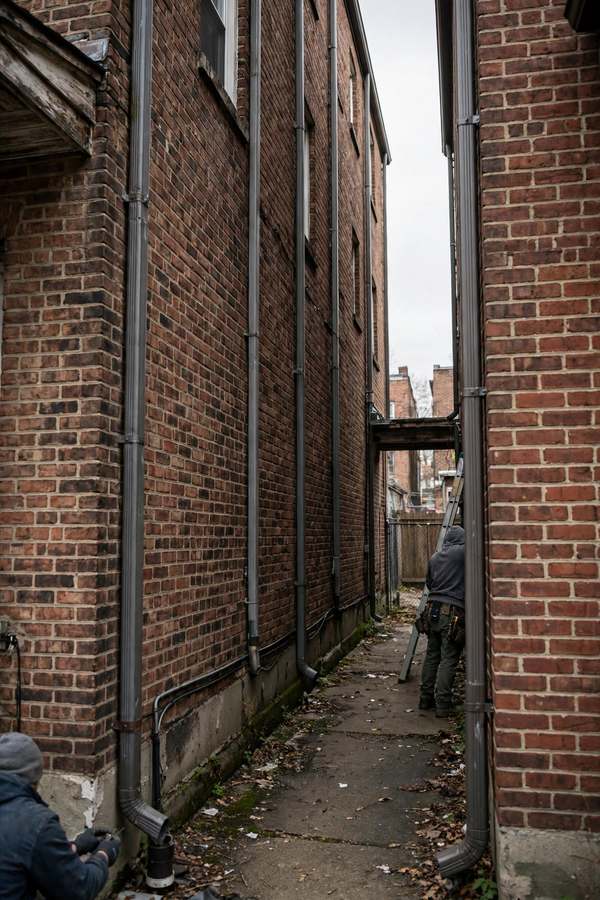
Shared leaders on attached rows are checked with the neighboring elevation in mind.

Call (872) 867-8606 →
Large older home with valleys and dormers above a new gutter run
Seamless Gutter Installation

A typical larger home with valleys and dormers

A typical larger home on a wide lot, with a multi-plane roof, several valleys, and dormers breaking the main eaves: water arrives at the gutters in concentrated streams rather than evenly along the run. The approach sizes troughs and outlets for those concentrated flows, places outlets at valley bottoms, and may step up to 6-inch runs on the longest elevations. Homes of this scale and variety are common in Beverly, where large lots and 1890-1930 houses produce rooflines that differ house by house.

Call (872) 867-8606 →
Problems we solve

Problems new gutters solve

These are the seamless gutter installation problems Chicago homeowners call about most, and how each one is approached.

Ask a pro →
01

Chronic overflow in heavy rain

Overflow at the front edge usually means the trough is full, the outlets are blocked, or the run is sized for less water than the roof delivers. May is the wettest month at both Chicago weather stations, so spring storms are the honest test of whether a system keeps up. Downspout repair is often part of the same answer.

↗
02

Runs pulling away from the house

A run that leans outward or gaps at the fascia is usually hanging from loose fasteners or soft boards, loaded by water, debris, and winter ice. Re-hanging alone will not hold if the boards behind it are failing, so the boards are read before the run is reset.

↗
03

Undersized runs on large roofs

Long runs and steep pitches deliver more water than a narrow trough can carry, and the excess spills at the lowest or most crowded point. Stepping up trough and downspout size, and adding an outlet where a valley concentrates flow, addresses the cause rather than the symptom.

↗
04

A profile that fights the house

A modern profile on a period home can look wrong and drain wrong, especially where original eave details, built-in troughs, or half-round sections survive. On designated blocks, the right move is to check before work begins, since historic review applicability to gutter work varies by address and designation.

↗
Proof you can check

Facts you can check before you call

  • 5.0-star Google rating · 17 Google reviews
  • Business address · 2332 N Laramie Ave, Chicago, IL 60639
  • Business hours · Mon–Sat 6:00 AM–5:00 PM, Sun 6:00 AM–1:00 PM
  • Phone · (872) 867-8606
  • Service area · Chicago, IL
Neighbors recommend us

What Chicago homeowners say

★★★★★
“The team came out in less than 24 hours to give a quote and started the job the same day. Very professional and did a clean job! We will be using them again! Highly recommend for guttter cleaning!”
DD

Dave DavisGoogle review · 2 years ago

★★★★★
“Santiago's gutter cleaning was a first time experience and I was pleased with the price effort and efficiency to make sure my gutters look like brand new and most importantly the professionalism that was presented to us for a first time customer.”
MV

Maria Del Rosario ValenciaGoogle review · 2 years ago · Translated from Spanish by Google

Good questions

Seamless Gutter Installation questions Chicago homeowners ask

(872) 867-8606 →

Seamless gutters are formed in long runs with joints mainly at corners and end caps, while sectional gutters join shorter lengths along the run. Fewer joints means fewer seam leaks over time. The seamless versus sectional comparison explains the trade-offs, including when sectional pieces still make sense for a short or awkward run.

Yes, replacement work includes removing the old gutters and downspouts so the new system is fitted to the eaves as they stand. The fascia boards are looked at while exposed. The signs that replacement is due help separate a system worth repairing from one that keeps failing across the whole house.

It depends on the roof: steep pitches, long runs, and large roof areas feeding one eave are the cases where wider troughs earn their place, usually paired with oversized downspouts. A look at the roofline settles it, since two houses on the same block can need different sizes. Call (872) 867-8606 during business hours to talk it through.

Zinc is not a standard service described on this site, and no Chicago installer was found offering zinc as a standard service in the research behind these pages. Material questions are settled by phone, where the options for a particular roofline can be discussed directly. Call (872) 867-8606 during business hours.

There is no single figure, because size, profile, material, and roofline complexity all change the job. Market ranges published by third parties are gathered on the Chicago gutter installation cost page, labeled with their sources. For a quote on a specific house, call (872) 867-8606 during business hours: Mon–Sat 6:00 AM–5:00 PM, Sun 6:00 AM–1:00 PM.

Ready when you are

Get seamless gutter installation help in Chicago

Call (872) 867-8606 during business hours — Mon–Sat 6:00 AM–5:00 PM, Sun 6:00 AM–1:00 PM — and tell us what is happening with your gutters.

Call (872) 867-8606 →
Get in touch by phone

Talk to a Chicago gutter crew

Call (872) 867-8606 during business hours. Tell us what is happening with your gutters and we will talk through the next step on the phone.

Call during business hours(872) 867-8606
Office address2332 N Laramie Ave, Chicago, IL 60639
Office hoursMon–Sat 6:00 AM–5:00 PM, Sun 6:00 AM–1:00 PM
↗
Questions?Call now