Gutter Cleaning in Chicago, IL

Gutter cleaning Chicago IL: seasonal clearing for tree-lined blocks

Gutter cleaning for Chicago homes, timed to the leaf fall and the spring rains, with downspouts cleared and checked as part of every visit.

Gutter Cleaning in Chicago, IL
About this service

Cleaning timed to Chicago seasons

Chicago's tree canopy shapes gutter cleaning more than any other factor. A United States Forest Service study counted roughly 3,585,000 trees in the city with 17.2 percent canopy cover in 2010, and single-family residential land holds just over half of the city's leaf area. Leaves, seeds, twigs, and the grit that washes off roofs all end up in the trough, and from there they travel to outlets and downspouts, where a small blockage can back water up along a whole run. Cleaning is the work of keeping that path open.

Timing follows two seasons. Fall leaf season peaks from September to November, when the heaviest debris arrives, and spring brings a second look after May, the wettest month at both Chicago weather stations, when winter debris and spring seeds have had their say. A twice-yearly rhythm is widely advised, and homes under heavy canopy or beside forest preserves often need the fall visit most. The preserve-wrapped blocks of Forest Glen and the mature-tree streets of Norwood Park are the kind of settings where leaf load is a season-long fact, not a one-time event.

Cleaning and repair are neighbors, not rivals. A visit that finds a leaking joint, a sagging run, or boards softening behind the trough says so, because clearing debris from a failing system only hides the failure for a season. Where guards are fitted, cleaning still matters: guards reduce what enters the trough, they do not remove the need to check it. Gutter guards and cleaning work together, and neither replaces the other.

  • ✓ Clearing the trough
  • ✓ Downspout cleaning
  • ✓ Seasonal maintenance visits
What's included

What gutter cleaning covers

Covered below: Clearing the trough; Downspout cleaning; Seasonal maintenance visits — and the rest of the checklist.

01
✓

Clearing the trough

Debris is removed from the full length of each run: leaves, seeds, twigs, shingle grit, and the compacted layer that forms where debris has sat through wet and dry spells. Corners and outlets get particular attention, since debris collects where water slows and turns. The trough is left open along its whole length, so water can travel to the outlet instead of ponding behind a dam of leaves.

02
✓

Downspout cleaning

A clean trough with a blocked downspout still overflows, so downspouts are cleared and tested as part of the visit. Elbows are the usual choke points, and a downspout that gurgles or backs up is worked until water runs through it cleanly. Where the trouble is damage rather than debris, downspout repair takes over, and the difference is explained on the spot rather than discovered at the next storm.

03
✓

Seasonal maintenance visits

Maintenance is cleaning on a rhythm rather than cleaning as a reaction. A fall visit clears the leaf peak before winter, when debris holds meltwater and adds ice load, and a spring visit clears what winter and the wettest month left behind. The rhythm is set by the trees over the house and the system's history. Tree-lined streets in Lincoln Square and Logan Square show why canopy varies by street.

04
✓

Homes under heavy tree cover

Homes under mature oaks, maples, and elms, and homes beside parks and forest preserves, collect debris faster and in greater variety: leaves in fall, seeds and catkins in spring, twigs after wind. No study ranks which species clog gutters most, so volume and timing matter more than species. These homes are the strongest case for the twice-yearly rhythm, with the fall visit as the anchor.

05
✓

What a visit checks along the way

Cleaning is also a look-over: joints weeping, hangers loose, runs sagging, outlets choked, and boards softening behind the trough are all visible while the debris comes out. Anything found is reported plainly, with repair discussed separately from cleaning. Where a run has drifted out of pitch, gutter repair covers the reset, and the cleaning visit is what brought it to attention before the next heavy rain.

How it works

How a cleaning visit runs

The visit starts with a call to (872) 867-8606 during business hours: Mon–Sat 6:00 AM–5:00 PM, Sun 6:00 AM–1:00 PM. The call covers the type of home, the tree cover over it, and when the gutters were last cleared.

The system is looked over before cleaning begins: runs, outlets, downspouts, and the boards behind the trough. Trouble spotted at this stage is noted, so cleaning and repair are not confused with each other.

Debris is removed from each run and from every outlet, working toward the downspouts. Compacted material at corners and outlets is cleared so water can move along the whole length of the trough.

Each downspout is tested with water to confirm it runs through cleanly and discharges where planned. A downspout that backs up is worked until it flows, and damage found in the process is reported.

Debris from the work is gathered from the work area, and anything the visit found, a weeping joint, a loose hanger, a soft board, is reported in plain terms with the next step discussed, not assumed.

Gutter Cleaning process in Chicago
STEP 01Call during business hours

The visit starts with a call to (872) 867-8606 during business hours: Mon–Sat 6:00 AM–5:00 PM, Sun 6:00 AM–1:00 PM. The call covers the type of home, the tree cover over it, and when the gutters were last cleared.

Tools & methods

Equipment in a cleaning visit

01
✓

Ladders and stable access

Ladders are set on stable, level ground for each elevation, from single-story bungalow eaves to taller rear walls. Overhead lines, soft ground, and slopes are checked before climbing, and the setup changes with the height of the run.

02
✓

Scoops and hand tools

Scoops and hand tools lift debris from the trough, including the compacted layer that settles at corners and outlets. Hand clearing reaches what a blower leaves behind and keeps debris out of the downspout while the run is being worked.

03
✓

Water for testing flow

Water run through the system after clearing shows whether each run travels to its outlet and each downspout discharges cleanly. Testing under water is what turns a cleared trough into a confirmed working system. The test covers every run and every leader.

04
✓

Buckets and debris bags

Debris is collected in buckets and bags as it comes out of the trough, rather than dropped onto the ground below. Gathering it as the work goes keeps beds, walks, and the work area tidy.

05
✓

Gloves and protective gear

Gloves and eye protection are worn for the work, since trough debris holds grit, sharp edges, and material that has sat wet through the seasons. Protection is part of the setup, not an afterthought. Debris is handled with care throughout the visit.

06
✓

Guard-aware handling

Where guards cover the trough, sections are lifted to reach the debris beneath and reset afterward without bending them. The boards behind the trough are read at the same time, and fascia repair is discussed if softening or rot shows.

Typical cases

Typical cleaning situations

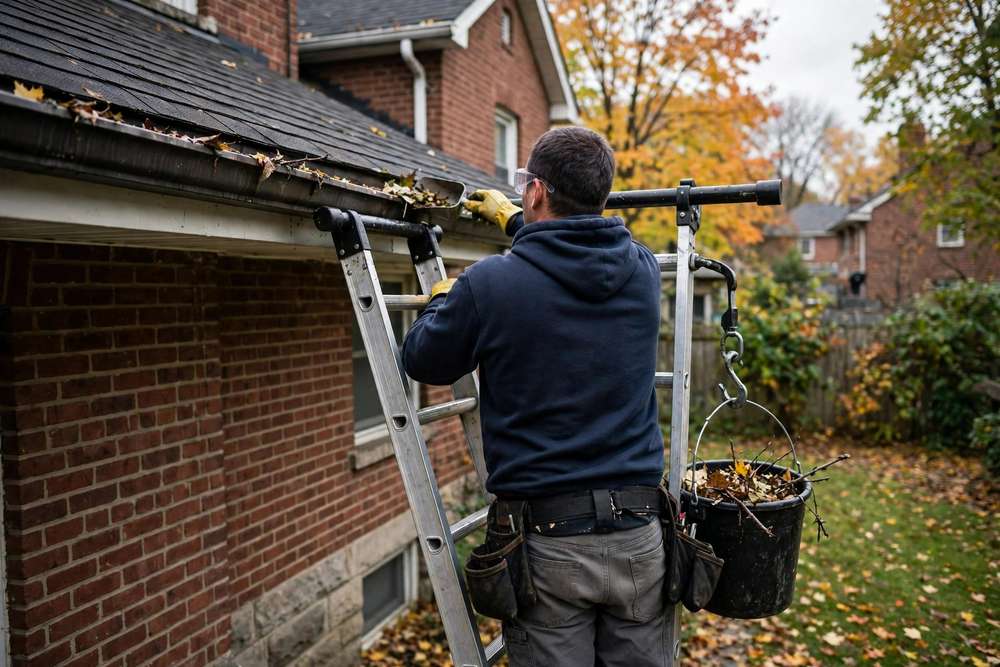
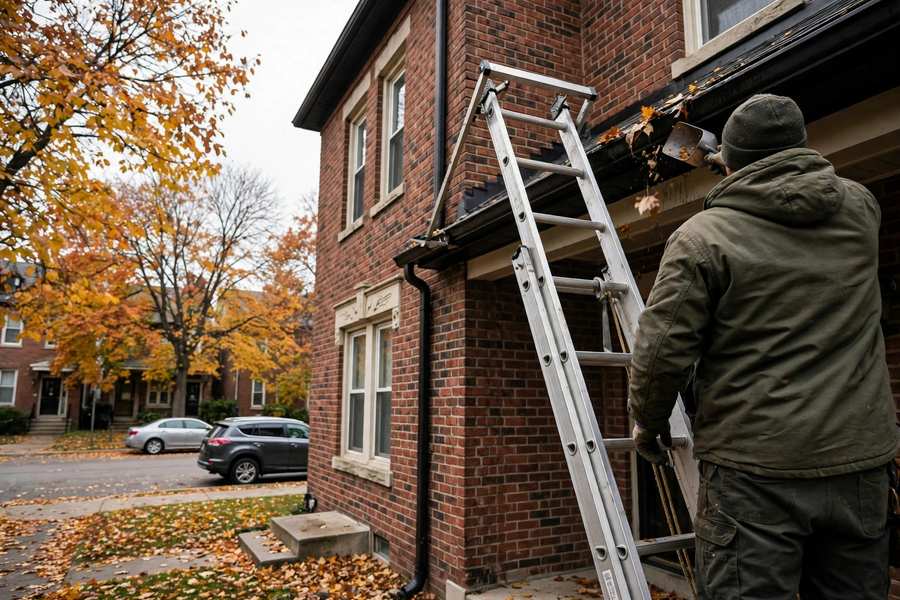
Bungalow gutter packed with autumn leaves before clearing
Gutter Cleaning

A typical fall visit under mature trees

A typical brick bungalow under mature parkway trees in October: the trough is packed with leaves, one outlet is choked, and water has begun spilling over the front edge during rain. The approach clears each run and outlet, tests the downspouts, and leaves the system open before winter, when debris would hold meltwater and add ice load.

The fall visit is the anchor of the year for homes like this, and the spring visit catches what winter left behind.

Call (872) 867-8606 →
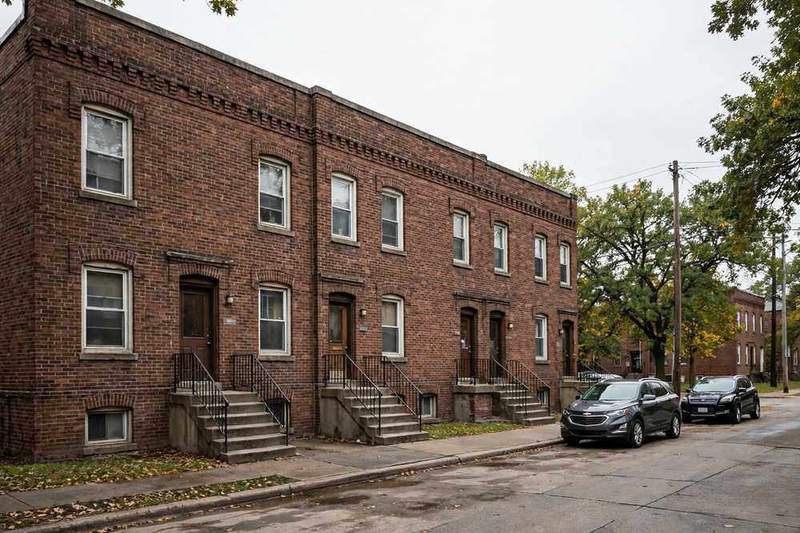
Flat roof edge with a scupper opening collecting leaves
Gutter Cleaning

A typical flat-roof two-flat with scupper debris

A typical flat-roofed two-flat where leaves and grit have collected at the parapet scuppers and in the rear leaders: water ponds on the roof edge after rain instead of draining away. The approach clears the scuppers and leaders and checks that water moves off the roof and down the rear elevation.

Flat-roof drainage fails quietly, since the trouble sits out of sight, which is why the seasonal look-over matters as much as the clearing itself.

Call (872) 867-8606 →
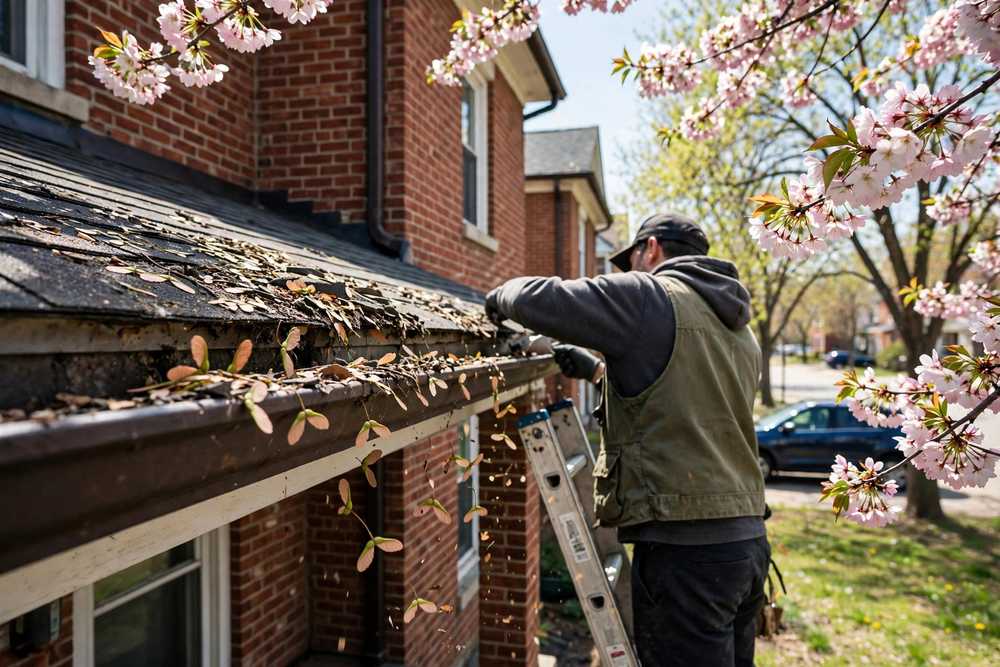
Spring gutter clearing with debris removed from the trough
Gutter Cleaning

A typical spring check after the wettest month

A typical spring visit after May, the wettest month at both Chicago weather stations: winter debris, seeds, and grit have settled into the troughs, and one downspout runs slowly. The approach clears the runs, works the slow downspout until it flows, and checks joints and hangers for winter movement. Park-edge blocks in Hyde Park, where canopy meets lakefront wind, are the kind of setting where a spring check earns its place.

Call (872) 867-8606 →
Problems we solve

Problems cleaning prevents

These are the gutter cleaning problems Chicago homeowners call about most, and how each one is approached.

Ask a pro →
01

Overflow from clogged outlets

A choked outlet backs water up along the run until it spills over the front edge, running down walls and soaking soil beside the foundation. Clearing the outlet restores the path water was meant to take, and testing under water confirms it stays open. The fix is clearing, not added capacity.

↗
02

Weight strain on runs and hangers

Wet debris is heavy, and a trough full of it pulls on hangers and joints through every storm. Over time the run sags, the pitch goes, and standing water speeds the next failure. Regular clearing removes the load before it bends the system. The fall visit removes that load before winter adds ice to it.

↗
03

Downspout blockages backing up

A blockage at an elbow or partway down a leader stops the whole run above it. The symptom is overflow at the top and silence at the bottom, and the fix is clearing the choke point, not adding capacity above it. Clogged downspout guidance explains the signs.

↗
04

Debris holding water against boards

Debris packed against the back of the trough holds moisture against the fascia boards, and damp boards soften over time. Clearing keeps the boards dry between storms, which is the simplest protection they have. Wooded eastern blocks in Morgan Park show the pattern clearly. Keeping troughs clear is the simplest protection boards have.

↗
Proof you can check

Facts you can check before you call

  • 5.0-star Google rating · 17 Google reviews
  • Business address · 2332 N Laramie Ave, Chicago, IL 60639
  • Business hours · Mon–Sat 6:00 AM–5:00 PM, Sun 6:00 AM–1:00 PM
  • Phone · (872) 867-8606
  • Service area · Chicago, IL
Neighbors recommend us

What Chicago homeowners say

★★★★★
“Santiago's gutter cleaning was a first time experience and I was pleased with the price effort and efficiency to make sure my gutters look like brand new and most importantly the professionalism that was presented to us for a first time customer.”
MV

Maria Del Rosario ValenciaGoogle review · 2 years ago · Translated from Spanish by Google

★★★★★
“Luis and his associate repaired my gutters quickly and cleaned them a bit for a fair price. I didn't hear any leaking during the last rain and I'm very pleased with the quality of work and efficiency. I would definitely recommend their service and will likely hire them again when time to clean the gutters. Se habla español.”
LS

La Shawn SGoogle review · 2 years ago

Good questions

Gutter Cleaning questions Chicago homeowners ask

(872) 867-8606 →

A twice-yearly rhythm is widely advised: fall, when leaves peak from September to November, and spring, after May, the wettest month at both Chicago weather stations. Homes under heavy tree cover may need the fall visit most, and homes beside parks and preserves should treat canopy as a season-long factor.

No. Guards reduce what enters the trough, but fine debris still gets in, and outlets and downspouts still need checking. A guard fitted over a trough that is never looked at can hide a developing blockage. Cleaning visits continue on a rhythm, with guard sections lifted and reset as part of the work.

Overflow at the top of the run, water spilling over the front edge during rain, and little or no flow at the discharge point all point the same way. The clogged downspout guidance and the overflowing gutters explanation cover the signs and the difference between a blockage and an undersized system.

Ladder work carries real risk, and height, slope, soft ground, and overhead lines all change it. The safe gutter cleaning notes set out the safety considerations honestly. Calling (872) 867-8606 during business hours puts the ladder work in the hands of people who do it every working day.

It depends on the size of the home, the height of the runs, the tree cover, and how long the system has gone uncleared. For a quote on a specific house, call (872) 867-8606 during business hours: Mon–Sat 6:00 AM–5:00 PM, Sun 6:00 AM–1:00 PM. Gutter Lake City - Gutters Installation & Repair is based at 2332 N Laramie Ave, Chicago, IL 60639.

Ready when you are

Get gutter cleaning help in Chicago

Call (872) 867-8606 during business hours — Mon–Sat 6:00 AM–5:00 PM, Sun 6:00 AM–1:00 PM — and tell us what is happening with your gutters.

Call (872) 867-8606 →
Get in touch by phone

Talk to a Chicago gutter crew

Call (872) 867-8606 during business hours. Tell us what is happening with your gutters and we will talk through the next step on the phone.

Call during business hours(872) 867-8606
Office address2332 N Laramie Ave, Chicago, IL 60639
Office hoursMon–Sat 6:00 AM–5:00 PM, Sun 6:00 AM–1:00 PM
↗
Questions?Call now